
Nursing school is one of the most rewarding journeys you can take—but let’s be honest, it can also be one of the most overwhelming.
Between lectures, clinical rotations, simulation labs, care plans, medication calculations, exams, and preparing for the NCLEX®, it often feels like you’re expected to memorize an entire medical textbook overnight. Most students quickly realize that success isn’t about memorizing every single fact. It’s about knowing where to find information, recognizing patterns, and building confidence one concept at a time.
When I was creating study resources, I kept asking myself one question:
“What do I wish I had sitting next to me every single time I studied?”
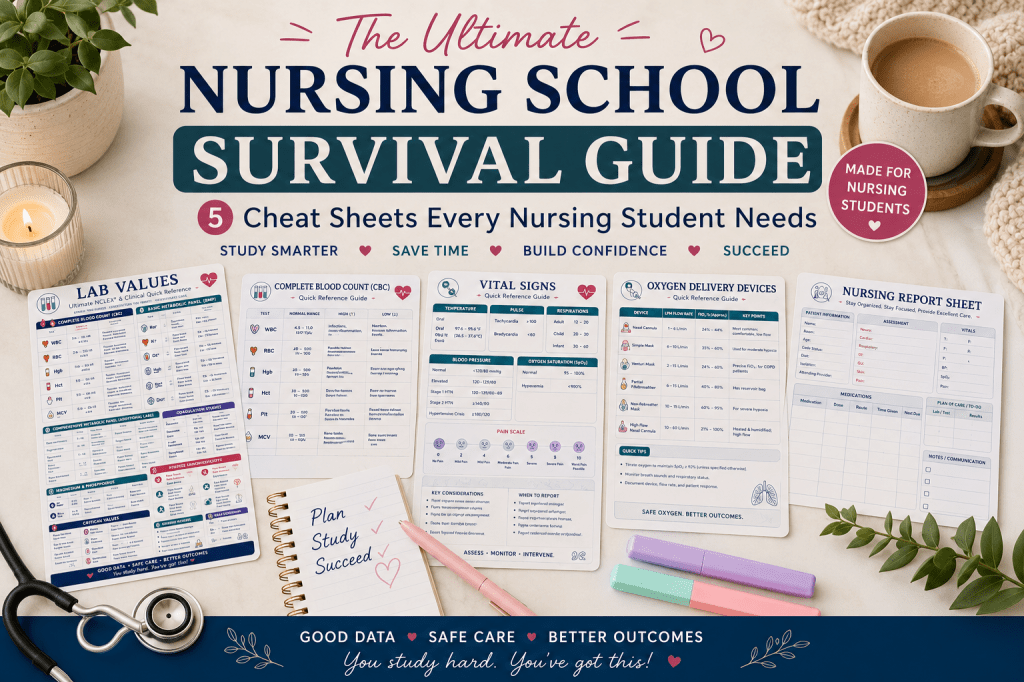
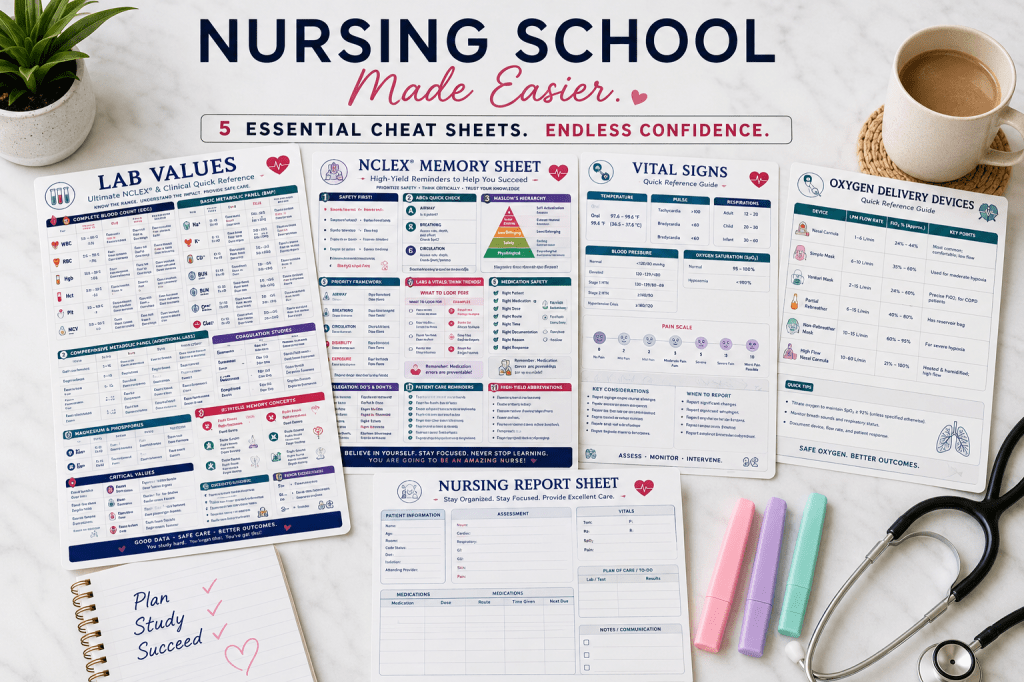
The answer became the foundation of the Ultimate Nursing School Cheat Sheet Bundle 1—a collection of five essential reference guides designed to simplify complex information into organized, easy-to-review pages.
Whether you’re just beginning nursing school, preparing for clinicals, or reviewing for your next exam, these sheets are designed to help you study smarter while reducing stress.
Why Nursing Students Need Quick Reference Sheets
Nursing isn’t like many other college majors.
You’re expected to connect anatomy, physiology, pharmacology, pathophysiology, assessment skills, communication, and critical thinking—all while providing safe patient care.
Instead of rereading hundreds of pages of notes every time you study, having concise reference sheets allows you to review the information repeatedly without becoming overwhelmed.
Think of them as your study companion—not a replacement for your textbook, but a tool that helps reinforce the concepts you’ve already learned.
The more often you see important information organized in the same format, the easier it becomes to remember during exams and clinicals.
What’s Included in Bundle 1?
Bundle 1 focuses on the foundational topics nearly every nursing student encounters during their first semesters.
1. Lab Values Cheat Sheet
Lab values can feel impossible at first.
There are dozens to memorize, and every instructor seems to expect you to know them instantly.
This guide organizes common laboratory values into a clean, easy-to-read format so you can quickly review:
- Complete Blood Count (CBC)
- Basic Metabolic Panel (BMP)
- Comprehensive Metabolic Panel (CMP)
- Kidney function
- Liver function
- Coagulation studies
- Therapeutic medication levels
- Common nursing considerations
Instead of flipping through multiple resources, everything is organized in one place.
Over time, you’ll begin recognizing normal ranges naturally rather than trying to memorize isolated numbers.
2. Complete Blood Count (CBC) Guide
Although CBC values are technically part of lab values, understanding what each result means is a completely different skill.
This guide helps you connect the numbers to patient care.
You’ll review:
- White Blood Cells (WBC)
- Red Blood Cells (RBC)
- Hemoglobin
- Hematocrit
- Platelets
Along with easy-to-understand reminders about why each value matters clinically.
Understanding why a lab is abnormal often makes remembering it much easier.
3. Vital Signs Reference Guide
Vital signs are one of the first assessment skills every nursing student learns.
But they quickly become more complicated than simply remembering normal numbers.
This guide includes organized references for:
- Temperature
- Pulse
- Respirations
- Blood Pressure
- Oxygen Saturation
- Pain Assessment
Having these values available during study sessions helps build confidence before entering clinical rotations.
As you gain experience, you’ll begin recognizing subtle changes that may indicate your patient is becoming unstable.
4. Oxygen Delivery Devices Cheat Sheet
Few topics cause as much confusion early in nursing school as oxygen delivery devices.
Questions like these are incredibly common:
- How many liters can a nasal cannula deliver?
- When should a Venturi mask be used?
- Which device delivers the highest oxygen concentration?
- What’s the expected FiO₂?
This reference sheet organizes the most common oxygen devices into an easy comparison chart, making them much easier to understand and review.
It’s one of those topics that becomes significantly less intimidating once you can see everything side by side.
5. Nursing Report Sheet Template
Studying is only part of becoming a nurse.
Learning how to stay organized during patient care is equally important.
A structured report sheet helps you organize:
- Patient information
- Medical history
- Assessments
- Medications
- Laboratory values
- To-do lists
- Provider communication
- Shift priorities
Many students discover that using the same report sheet consistently helps reduce anxiety during clinical rotations because they always know where to write important information.
How These Sheets Can Improve Your Study Routine
Everyone studies differently, but consistency is what leads to long-term retention.
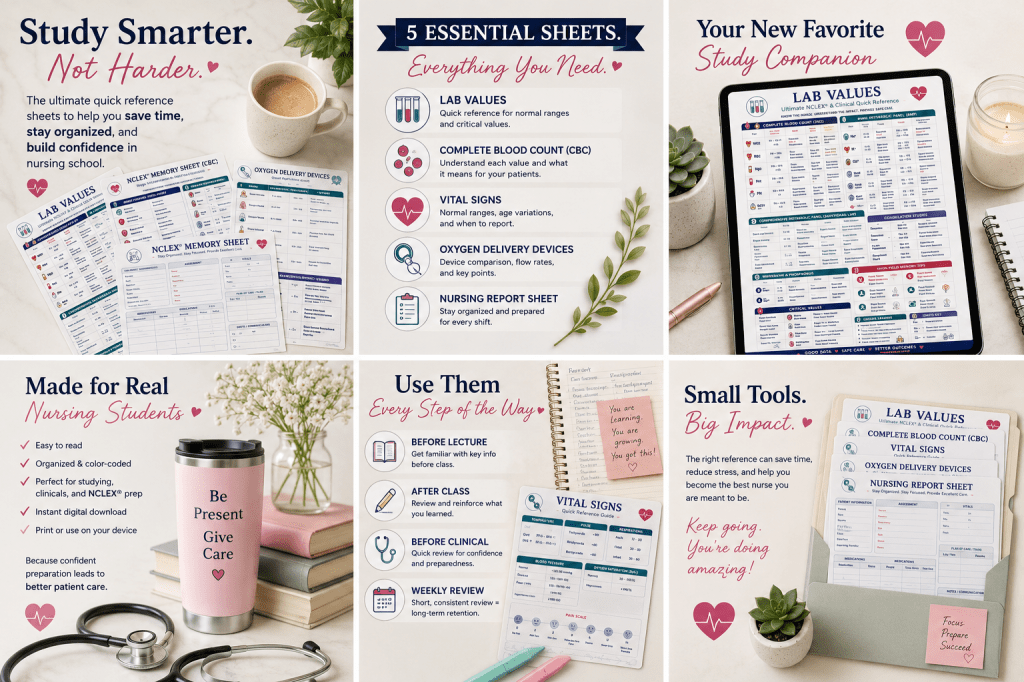
Here are a few ways you can incorporate these guides into your routine:
Before Lecture
Spend five minutes reviewing the related cheat sheet before class.
Having a basic framework already in your mind makes lectures much easier to follow.
After Class
Instead of rereading an entire chapter, compare your notes to the reference guide.
Highlight information you still need to review.
Before Clinical
Review:
- Lab values
- Vital signs
- Oxygen devices
Even a quick review can increase your confidence before patient care.
Weekly Review
One of the biggest mistakes nursing students make is only studying before exams.
Instead, spend 15–20 minutes each week reviewing these sheets.
Short, consistent review sessions help move information into long-term memory.
Designed to Be Aesthetic Without Sacrificing Accuracy
Let’s be honest—we’re all more likely to use study materials that are visually appealing.
But aesthetics should never come at the cost of accuracy.
Every sheet in Bundle 1 is designed with a calm, clean layout that’s easy on the eyes while keeping the educational content front and center.
The goal isn’t simply to create pretty notes.
The goal is to create study resources you’ll actually want to use again and again.
Built by Someone Who Understands Nursing School
These guides weren’t created simply to look nice.
They were inspired by the challenges nursing students face every day.
Long nights studying.
Feeling overwhelmed before exams.
Walking into clinicals wondering if you’ve remembered everything.
Questioning whether you’re smart enough to become a nurse.
If you’ve ever felt that way, you’re not alone.
Every experienced nurse started exactly where you are.
Confidence doesn’t happen overnight—it grows with every lecture, every patient interaction, every exam, and every small victory along the way.
Sometimes having the right study tools simply makes that journey feel a little less overwhelming.
A Gentle Reminder for Every Nursing Student
You do not have to know everything today.
You only have to keep learning.
Some days you’ll feel incredibly confident.
Other days you’ll wonder if you’ll ever understand cardiac rhythms or medication calculations.
Keep showing up anyway.
Every quiz you pass…
Every skill you practice…
Every patient you care for…
Every page you review…
It all adds up.
One day you’ll look back and realize that the concepts that once felt impossible have become second nature.
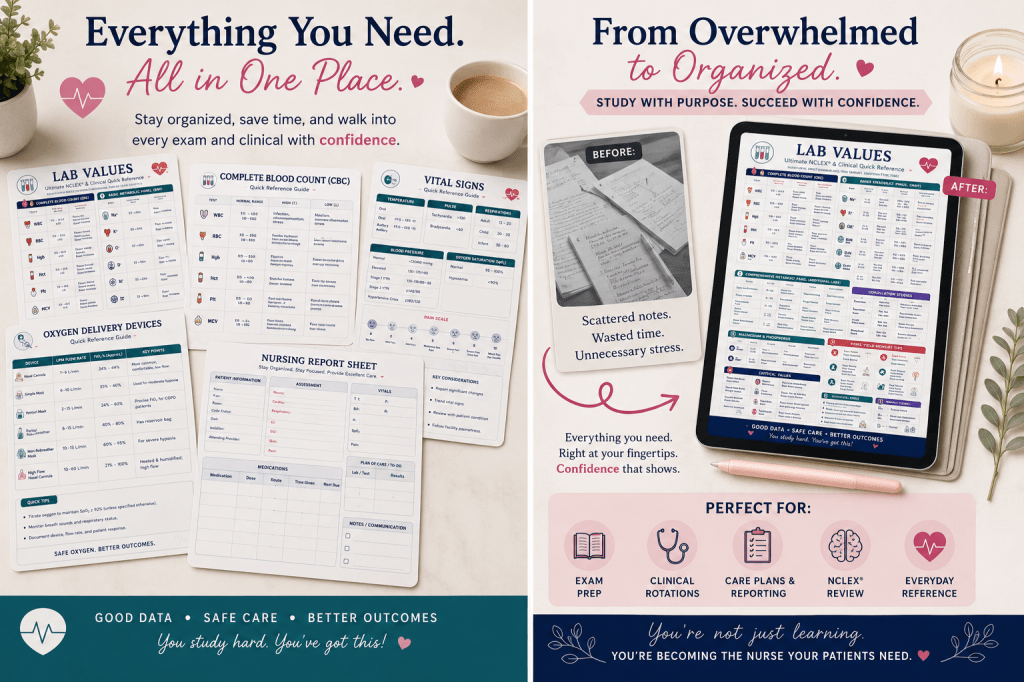
If you’re looking for a simple, organized way to review the foundations of nursing school, the Ultimate Nursing School Cheat Sheet Bundle 1 was created with you in mind.
Inside you’ll find beautifully organized reference sheets covering:
- Lab Values
- Complete Blood Count (CBC)
- Vital Signs
- Oxygen Delivery Devices
- Nursing Report Sheet
Whether you’re studying for your next exam, preparing for clinicals, or reviewing for the NCLEX®, these printable digital guides are designed to help you stay organized, build confidence, and spend less time searching through scattered notes.
Remember: becoming a great nurse isn’t about being perfect. It’s about showing up, staying curious, and continuing to learn.
You’ve already taken the hardest step by beginning your journey.
Keep going.
You’ve got this.


Leave a Reply